Group meetings
Please come back soon to find out details of our next meeting.
For those that would like to join the group (or confirm their membership) please email Helen Chapman.
For further information, please contact the Group secretary.

Wristwatch Group
Welcome to the home page of the Wristwatch Group, a specialist group within the AHS.
There has been an increased interest in vintage and antique wristwatches in recent years, but a perceived lack of corresponding published scholarly research. The Wristwatch Group exists to promote and encourage the study of the history and development of wristwatches through meetings, education and publications, including articles in the Journal or technical papers for Group members.
Members of the Wristwatch Group have regular meetings in the form of lectures, short talks, bring-and-discuss sessions, and visits to exhibitions, private collections and centres for the practice and study of watchmaking both in the UK and abroad.
The Group brings together enthusiasts keen to learn more about the origins, makers, techniques, family and corporate histories and indeed any of the material and cultural aspects associated with wristwatches. All are welcome, whether new to the subject or recognized authorities.
The group is chaired by Richard Stenning with support from secretary Nikos Gorgoraptis and treasurer Mat Craddock.
Membership of the Group is open to any member of the Antiquarian Horological Society. To join the Wristwatch Group, or to find out more, please email wwg@ahsoc.org.

Past meetings
Some History and Explanation of Engine Turning
4 Lovat Lane, London, 21 July 2026
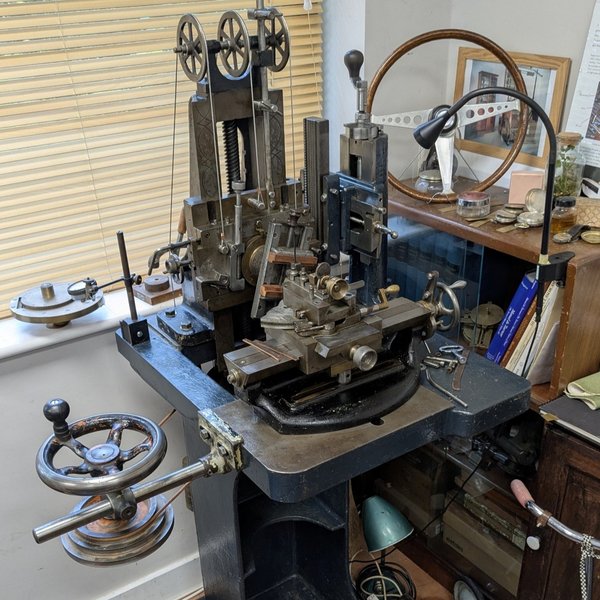
Seth Kennedy came to Lovat Lane on the evening of Tuesday 21 July to talk about engine turning, a craft he practises as one of very few doing so professionally: engine turning is on the Heritage Crafts Red List as critically endangered. It is a subject better shown than described, and Seth had given careful thought to conveying, to a mixed audience, both the history of the technique and the workings of the machines that produce it.
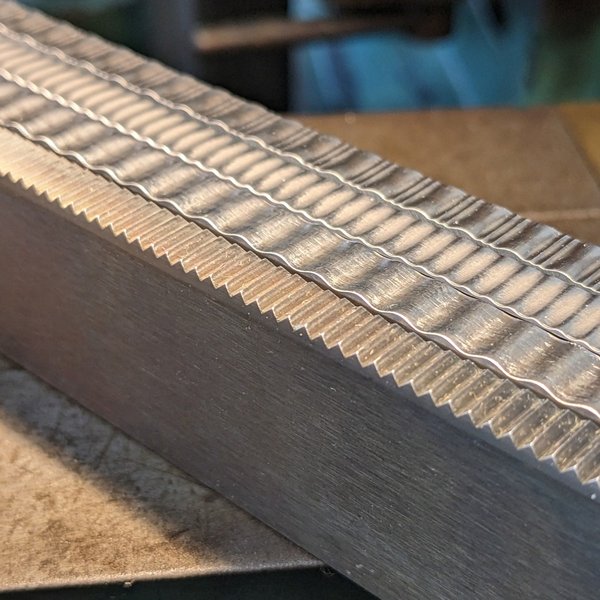
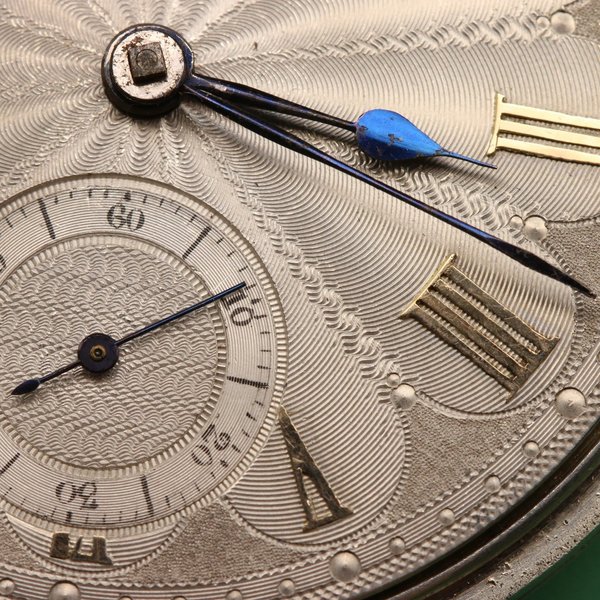
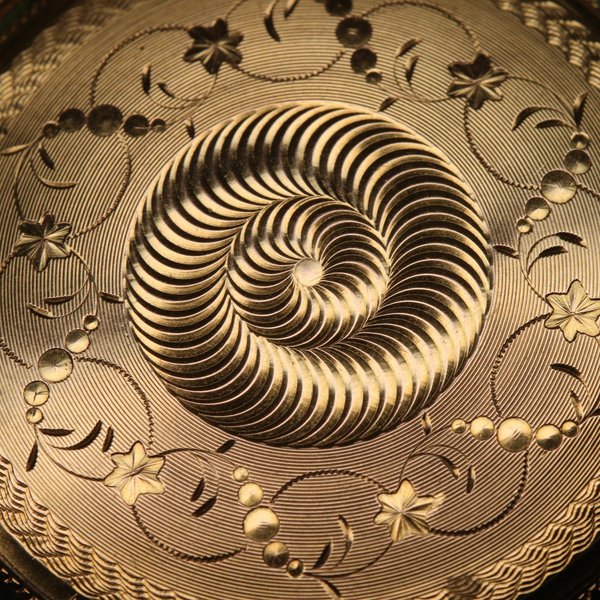
He began with what engine turning actually is: known also by its French name, guilloché, it is a semi-mechanised engraving process, worked by hand, in which a cutting tool bears on a surface that moves against it in a controlled way, producing the even, geometric patterns familiar from watch cases and dials. Seth showed how much of the finished work's character rests with the person at the machine.
On the history, he traced the technique from the ornamental turning of earlier centuries to its arrival on watch cases in the late eighteenth century, and on through the nineteenth and into the twentieth, applied across much of the decorative metalwork of the period.
The heart of the talk was the machines: the rose engine and the straight-line engine, and how the rosettes govern the pattern. He explained how tool, rosette and hand combine to produce the many named grounds, among them barleycorn, basketweave and clous de Paris, and pitched it just right for an audience of varied familiarity.
The evening was well-attended and conversation continued after the talk, when attendees had the opportunity to experience interesting examples of engine turning hands-on. Our thanks to Seth Kennedy.
Nikos Gorgoraptis
All images courtesy of Seth Kennedy
Marine, Pocket and Wristwatch Chronometers: The Story of Charles Frodsham
4 Lovat Lane, London, 10 February 2026
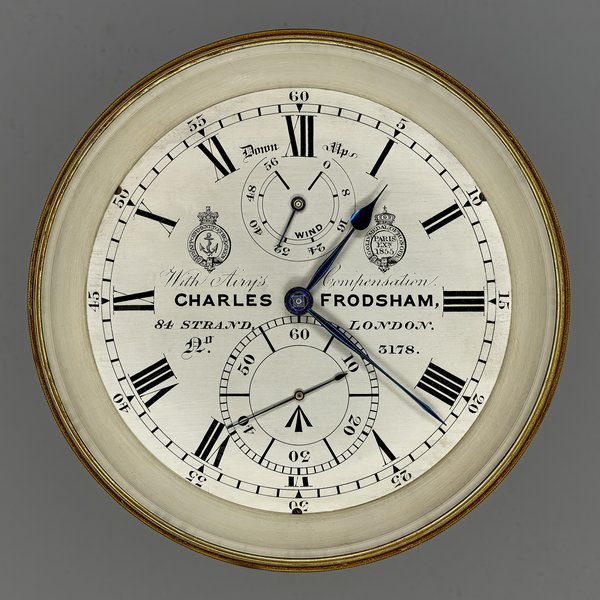
Richard Stenning came to Lovat Lane on the evening of Tuesday 10 February to tell us the story of Charles Frodsham. He gave a generous account of nearly two centuries of a single firm, from its inception to its modern-day production.
Richard began with Frodsham's early years as an apprentice to his father. Charles Frodsham then distinguished himself as a maker of marine chronometers, with which he supplied the Admiralty, a demanding customer. For the Great Exhibition of 1851 Frodsham introduced a new calibre of chronometer, and Richard traced the medals that followed at the world's exhibitions. Two business acquisitions shaped the firm: Arnold in 1843 and Vulliamy in 1854. In the same year, Frodsham was appointed Superintendent and Keeper of Her Majesty's Clocks at Buckingham Palace. He was, as Richard explained, an unusually erudite writer on horological subjects.
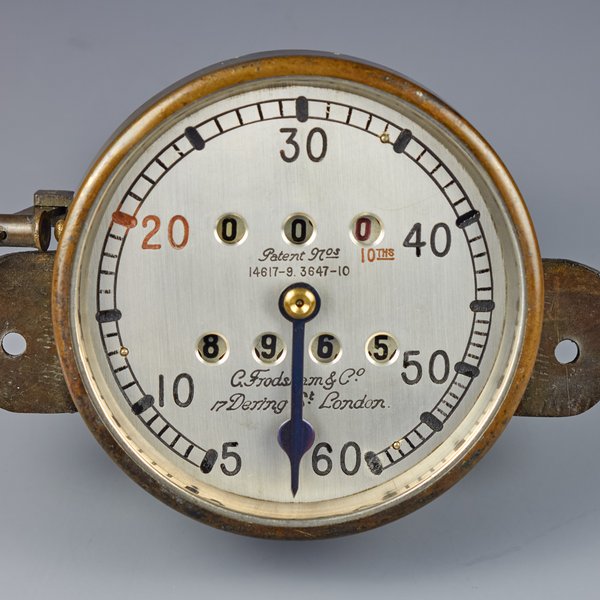
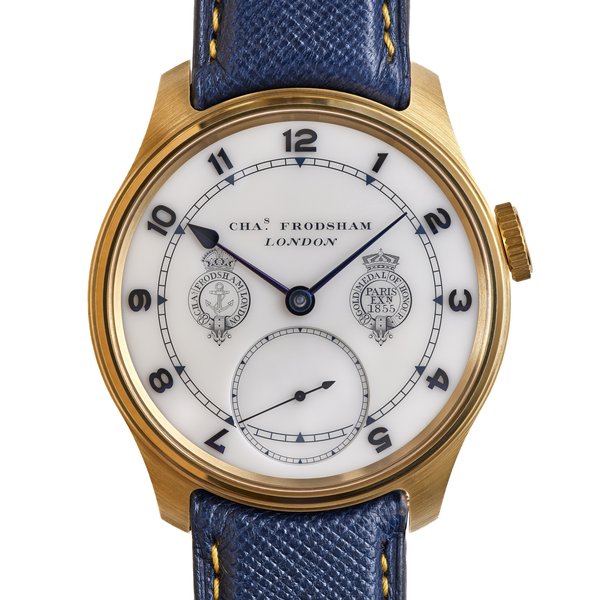
The talk then opened outwards: the firm’s American agents, Tiffany and Willard; observatory regulators; pocket chronometers; and some dazzling pieces made for J. P. Morgan, among them a chronometer the financier offered his personal physician. Speedometers and car clocks came as a surprise. Turning to the modern era, Richard described the company’s work on Harrison's H3 and H4. Then he recounted the long development of the company’s modern wristwatch and its double impulse chronometer escapement, running back through George Daniels and Derek Pratt.
Questions ran on well past the end, answered with patience and good humour. Our thanks go to Richard Stenning, and to all who made the evening a memorable one.
Nikos Gorgoraptis
All images courtesy of Charles Frodsham & Co. Ltd.
Electric Watches Before Quartz
Joint meeting with the AHS Electrical Horology Group
4 Lovat Lane, London, 9 November 2024
Charles Ormrod and Andrew Nahum joined the AHS Wristwatch and Electrical Horology Groups at their joint meeting at Lovat Lane on Saturday 9 November. The focus was on electric watches before quartz. Charles began with a presentation on the Hamilton Electric 500, the world’s first electric watch, launched in January 1957. It employed a balance impulsed by an electromagnetic coil mounted on the balance itself, which interacted with permanent magnets fixed to the watch frame. The switching arrangement involved two extremely fine rigid wires. It was astonishingly delicate and therefore an Achilles heel. Hamilton employed a gifted industrial designer, Richard Arbib, to give the watch a modernist aesthetic. It was, as Charles observed, “the watch of the future inside and out.” Other firms followed in Hamilton’s wake, with Lip launching its first electric watch in 1958 and Elgin in 1961.
There was a competitor to the electric balance wristwatch – the Bulova Accutron tuning-fork watch, the subject of Andrew’s talk. Coming from a world of tone control, Max Hetzel, inventor of the Accutron, abandoned the balance in favour of the tuning fork as the oscillator, managing to couple the vibrations of the fork to the advancement of a near miraculously finely cut countwheel using a pecking pawl. Performance was excellent and Bulova’s advertising was highly successful, leading to big profits. The Accutron found applications across aerospace, the military and industry, as well as on consumer wrists. From 1968, Ebauches SA of Switzerland enjoyed a licence to devise an improved Accutron design, and alongside a number of other Swiss brands, Omega became the most prolific maker of tuning-fork watches, achieving the distinction of chronometer status. The tuning fork movement was not a curiosity or lacuna in watch history but a major feature in high-end watch production, a story the ensuing quartz revolution perhaps obscured.
The day was very well-attended and discussions continued after the talk, when attendees could get their hands on examples which members had brought along. Many thanks indeed to Charles Ormrod and Andrew Nahum.
Lips, Quasars and Flightmasters
4 Lovat Lane, London, 30 April 2024
An enthusiastic crowd gathered at Lovat Lane on Tuesday 30 April for the first meeting of the relaunched Wristwatch Group, with Richard Stenning as Chair, Chris Mann as Secretary and Mat Craddock as Treasurer. Over a welcome glass, three presentations explored contrasting episodes in wristwatch history.
Nikos Gorgoraptis, consultant neurologist at St Bart’s Hospital, traced the history of LIP, founded in Besançon in 1867. An early pioneer of radioluminescent dials, LIP became France’s largest watchmaker by 1935. Under the flamboyant Fred Lip, production expanded substantially, with electromechanical developments and adventurous designs following. However, financial pressures and workforce cuts in the 1970s prompted an extraordinary factory occupation, during which workers maintained production and sales. Despite subsequent innovation, political and commercial pressures led to closure and redundancies, followed by worker-led co-operative ventures. LIP was revived in 1990. Nikos also highlighted the company’s special Greek-dial watch, reflecting contemporary Greek history and drawing on earlier advertising themes.
James Nye recounted the curious story of Smiths’ Quasar quartz watch, developed from the late 1960s by the company’s Special Horological Products unit under Dr Shelley. Despite being revealed at the 1973 Basel Fair, the project was cancelled before launch after management concluded, following a visit to Seiko, that competition was futile. Several examples have since resurfaced, apparently preserved by Cheltenham technicians who continued testing after cancellation.
Chris Mann concluded with a presentation on the Omega Flightmaster, introduced in 1969 as a purpose-designed pilot’s watch. In a large, legible case, the watch evolved through three iterations, with improvements to water resistance. Early models featured a 24-hour GMT sub-dial, subsequently replaced by running seconds. Yellow or cadmium-coated hands, together with colour-coded pushers, enhanced visibility, including under infra-red cockpit lighting.
All three talks were warmly received, prompting lively discussion. Many thanks to Nikos, James and Chris!
Trends in Horological Typography
The Clockworks, London, 28 April 2019
Details matter. This was the overarching point made in a fascinating structured discussion between Mat Craddock and interdisciplinary designer Lee Yuen-Rapati at The Clockworks in April. Mat took Lee’s Masters dissertation, titled ‘Motivating Factors In The Trends Of Horological Typography,’ as the basis for an exploration of the typographical decisions, the typefaces used and the importance of type design to some high-profile brands’ revival watches.
It was a talk of equal interest to ‘typenerds’ and ‘watchnerds’ alike. Their discussion covered various themes and illustrated some typographic pitfalls that appear to be specific to wristwatches. Highlights included the use of default typefaces, pre-installed on modern computer systems, by high end watch manufacturers which have resulted in some surprising (and not in a good way) results on expensive and high-profile models. Mat and Lee discussed the technical limits of pad printing; the benefits and issues associated with modern processes of dial design (such as the digital workspace); and pointed to a number of inconsistent choices made by watch brands when reviving their older designs.
Finally, Lee discussed recent advances in dial printing, such as the use of physical vapour deposition on the zirconium ceramic dials of the Charles Frodsham Double Impulse Chronometer, suggesting that this technology might be taken up by other watch manufacturers. Suffice to say that no-one who attended the talk will ever look at a watch dial in the same way again.
Watch Cases
The Clockworks, London, 13 January 2019
For our first meeting of the year, we welcomed Seth Kennedy to The Clockworks. Mr Kennedy is a London-based antiquarian watch and case maker. He started his early career in engineering, but for the last fifteen years he has been working in horology. In his early years he was mentored by an accomplished watch and case maker in London where he learned the skills needed to make and repair pocket watch cases.
Mr Kennedy gave us a two-part talk. The first was a whistle-stop tour of pocket watch cases and their development over the last 350 years, illustrated with some excellent photographs of watches that he has worked on. Whilst necessarily a quick overview of case making history Mr Kennedy gave an excellent account of pair cases, hunter and half hunter cases and 5,7, even 9 knuckles hinges. The second part of the talk provided a fantastic insight into how he makes pocket watch cases from scratch. Because cases are made bespoke, most of the tools, jigs and presses he uses are self-made. One particularly interesting point we learned was that the order in which the pieces of a case are soldered together is highly important, otherwise the case may fall apart as you’re making it.
Mr Kennedy finished his talk with a video of the stunning ‘Cabriolet’ dual-pivot case which he made recently for a lucky client. It is a fantastic piece of craftsmanship. Our thanks go to Mr Kennedy for giving us such an inspiring, informative and insightful talk. And to The Clockworks for hosting a very enjoyable afternoon. See more at sethkennedy.co.uk
Silas Walton, A Collected Man
The Clockworks, London, 11 October 2018
We welcomed Silas Walton, Founder of ACollectedMan.com, to the beautiful and intimate surroundings of The Clockworks in South London. Formed in 2014 as a platform for the sale of premium vintage and independent-made mechanical watches, Mr Walton’s company has achieved the rare distinction of being approved by leading independent watchmakers such as Philippe Dufour, Roger Smith, Kari Voutilainen, Laurent Ferrier and MB&F.
Mr Walton’s presentation focussed on a few of the key aspects in watch collecting: provenance, condition and the role of craft being among them. He was also happy to recite a few anecdotes about his time with some of the famous watchmakers he works with, and to provide a history of his company and its development.
Discussion among the group centred on current and future trends in wristwatch collecting and the need for differentiation among dealers in a highly competitive market. Mr Walton explained that ACollectedMan has always adopted a ‘digital-first’ approach, making extensive use of social media and the internet to reach its international client base. He also brought a number of impressive and collectable wristwatches with him to illustrate his talk. These included a special Jaeger Le Coultre ‘London Edition’ Reverso and a 1964 Breitling AV-1 originally owned by an RAF pilot stationed in Yemen. But perhaps the most attention-grabbing piece was a unique R.W. Smith Series 2 cased in stainless steel, sourced specially by Mr. Walton for a lucky client.
Mr. Jones Watches
London, 28 June 2018
South London-based Mr Jones Watches welcomed members of the Wristwatch Group to their workshops on 28 June. Mr Jones’s eponymous founder (who is also a Wristwatch Group member himself) outlined the history of the firm, from its roots in 2007 to the present day. Like many modern British watches, these were originally produced entirely in China, with only the design taking place in London. Using Chinese quartz and mechanical Seagull movements, the watches offer a certain quirkiness, from memento mori-inspired slogans to chattering skulls with jump hour teeth. However, as the team’s skills have grown and the complexity of their hand-printed dial designs has increased, Mr Jones has insourced assembly of all their limited-edition watches as well as the production and pad printing of the dials.
Bringing production back in-house reduces lead times, allows for quicker prototyping cycles and provides a greater degree of control over the finished product. Many of these pad-printed dial designs require multiple colours and layers of ink, a process at which many of us were keen to try our hand. Working closely with British artists, Mr Jones has built up a business that now sells watches to customers worldwide, with the majority of those pieces being assembled in their South London studio. Although many group members were previously aware of the brand, few of us had realised quite how much of the overall production was now carried out in the UK. Our thanks go to Crispin Jones and all at Mr Jones Watches.


Sotheby's Sale Viewing
The Clockworks, London, 16 April 2018
Ahead of the start of the auction sales season the Wristwatch Group were treated to an intimate evening at The Clockworks in the company of Charlie Foxhall from Sotheby’s who kindly brought along some 40 watches and pocket watches from the following day’s ‘Fine Timepieces’ sale in London. The selection of lots included a newly discovered half quarter repeating lever pocket watch by Josiah Emery; a rare Patek Philippe with hand-painted enamel dial (Ref: 5089G-061) and a limited edition alacrite and titanium tourbillon Royal Oak concept watch by Audemars Piguet. Also present were lots from Heuer, Rolex, Dent, Omega, Meylan, A. Lange & Söhne and Lemania, among others. It was a wonderful opportunity for the group to inspect the watches close up and to learn about them from a Sotheby’s expert (and Wristwatch Group member). The group is grateful to Charlie Foxhall, Sotheby’s, and to The Clockworks for their kind support in hosting the event at short notice.
Peter Speak-Marin, 'The Naked Watchmaker'
The Clockworks, London, 23 February 2018
The Wristwatch Group welcomed Peter Speake-Marin to The Clockworks to talk about his new online project, ‘The Naked Watchmaker’. Peter took us through his background from student at the Hackney School of Watchmaking and WOSTEP (Watchmakers of Switzerland Training and Educational Program), to his work as a vintage watch repairer and restorer in London. Having recently stepped down from running his own watch brand Peter explained that he is now focussed on a new educational challenge. Designed to be a digital receptacle of horological information, Peter explained the concept of ‘The Naked Watchmaker’ by taking us through a number of watch movement deconstructions, from chronographs such as the Valjoux 22 to the Rolex 3130. He provided observations about movement design and functionality. By using high-quality photography and video to illustrate the deconstructions he hopes to inspire a new generation of horologists who are interested in the movements themselves and not just their investment value. Peter took a number of questions from the audience who were particularly interested to hear his own views on individual movements, and more about his website at thenakedwatchmaker.com The group is grateful to both The Clockworks and the International Watch Seminar for their kind support.

An Evening With the Smiths Mk 10 Military Watch
The Clockworks, London, 28 June 2017
The Wristwatch Group event was hosted this time at The Clockworks in West Norwood. Owen Gilchrist, a watch repairer and expert in the field of Smiths watches gave his talk while dismantling and reassembling a Smiths Mk 10 military watch. Owen had set up his watchmaker’s bench with a camera and projector, which gave viewers a watchmaker’s-eye-view of the movement being disassembled. This made the room go very quiet from time to time with people captivated by Owen at work.
During reassembly, Owen talked us through all the parts of the watch plus the history and development of the Mk 10. There was lots of interest from the audience which led to many vibrant discussions on various parts and subjects. Furthermore, there are still some mysteries regarding the movement and its use. The watch on its own is a rare piece and more research would be required to create a clearer picture of the development, the numbers made, and how the watch could be dated base on the serial numbers. There was a small break during his talk, in which a well-deserved drink and sandwich could be enjoyed. The evening carried on after the lecture with a lively discussion on Smiths watches, with some very rare examples brought in by a member of the audience.
London Craft Week: Vacheron Constantin
Vacheron Constantin Boutique, Bond Street, London, 6 May 2017
Wristwatch Group members were offered the chance to visit Vacheron Constantin to see their London Craft Week exhibition. The brand is very supportive of traditional watchmaking crafts and is keen to showcase their abilities, so a hand engraver from Geneva had taken up residency in the Bond Street Boutique. She showed her skills via a microscope and projector, and guests were able to see the various stages of work required to create the dials used on the ‘Métiers d’Art’ Copernicus watch, which features depictions of the twelve creatures of the zodiac, along with a sun and earth. To manipulate light reflections creating an impression of depth in a dial less than half a millimetre thick takes not only months of time, but also incredible skill. The engraver described how long it has taken to achieve her skills, explaining her four-year tenure at a Parisian art college before gaining years of experience slowly moving towards the microscopic sized engraving used in watches.
Guests were also treated to the opportunity to meet the brand’s Creative Director, Christian Selmoni, who spoke frankly about the watch industry, his company’s position and interests, as well as his own passions and horological idols. To hear the confidence he had not only in his company, but in the creative and technical integrity they held, was not only fascinating, but refreshing as he had no issue comparing himself with competitors and even admitting where other brands were responsible for saving arts that Vacheron now relies on, such as Patek Philippe almost single-handedly keeping enamelling alive.


Wristwatches at the British Museum
British Museum, London, 19 October 2016
Members attending the Wristwatch Group’s autumn event were treated to a rare experience – a group visit to the British Museum’s study room to see a selection of wristwatches presented by Laura Turner, a horological curator at the museum. Attendees were given a whistle-stop tour through many major points in the history of the wristwatch, showing watches from the museum’s collection supported by a computer presentation.
This tour started with a wrist- mounted pocket watch worn by soldiers from the late nineteenth century, and notably seen on the wrists of many soldiers in the Great War. This led onto the forms of protection for the glass and dial seen on trench watches, and then methods taken to protect the movement – the first examples of the automatic wristwatch! We were shown many methods that were explored, including the now-famous Harwood self-winding watch, and less popular methods, such as one which allowed the movement to ‘bounce’ inside its case, allowing a finger to index the ratchet wheel. The subject of protection finished with the Rolex Oyster case, arguably the advent of the modern watch case, and the museum has a stunning early example of this case.
The tour then moved on to other technical advancements, touching on electrical horology with the Hamilton/Buren Electromechanical movement which originally used bean-shaped batteries, as well as the Bulova tuning fork watch and an early LED-display watch by Pulsar.
Laura gave a fantastic presentation which covered a wide range of items with an in-depth knowledge of them all. The hour-long session was both interesting and engaging and it was very clear that the groups would have been happy to spend all day absorbing the information and viewing the rarities held by the museum.
Bring and Discuss: Unusual Cases and Displays
Soho, London, 21 June 2016
On the longest day of the year, the Wristwatch Group met in the heart of Soho for its first bring-and-discuss event. With a theme of unusual cases and displays to help members choose which watches to bring, there was, as expected, a fascinating range of examples from throughout history.
The evening began with electric watches, including a 1950s Epperlein with a display caseback. Perhaps this was a demonstration model, allowing customers to admire the revolutionary technology within? This prompted the appearance of a vintage Hamilton Ventura, complete with original box and papers, famously worn by Elvis and featuring one of the most unusual cases around. An iPhone provided clear slow-motion footage of both electro-mechanical movements running together.
A 1980s digital Casio with a connected heart rate monitor offered a glimpse of the technology that may have paved the way for today's smartwatches and health trackers.
LED watches were another recurring theme. Members saw a modern reissue of a Polish watch made famous by a Soyuz-programme astronaut, whose remarkable quirk was a battery life of just two weeks. British design was represented by the Sinclair Black Watch, of ZX Spectrum fame. Its original instructions warned against frequent demonstrations, which could shorten the life of its two hearing-aid batteries.
Returning to more traditional designs, a c.1916 trench watch featured hour markers larger than those on many modern dive watches: stylistic choice or practical necessity?
The final highlight was a late-1960s Jaeger-LeCoultre Polaris, one of approximately 1,700 made. Combining a mechanical alarm with a diver's watch, its ingenious double caseback used 16 holes in the outer case to let the alarm sound while the inner case maintained water resistance.
The evening concluded with lively discussion of the watches, horological stories and more. The theme inspired a wonderful selection, and we look forward to the next gathering.
How Original! The Impact of Originality on Collectable Wristwatches
The Watch Club, Old Bond Street, London, 14 January 2016
A cold January evening is, perhaps, not the best time to hold an outdoor event. However, a brisk chill was not going to stop thirty members of the AHS’s Wristwatch Group (WWG) and invited guests from enjoying a discussion on the impact of originality on collectable wristwatches. Titled How Original, the event brought together collectors, watchmakers and sponsor Justin Koullapis of The Watch Club.
In the patio heater-fired warmth of the Royal Arcade, attendees heard from Mr Koullapis, Adam Phillips (casemaker and restorer), Greg Dowling (watch collector) and Oliver Cooke (Curator, Horological Collections at the British Museum) in a discussion led by former Wristwatch Group Chair, Rebecca Struthers.
Mr Cooke outlined the curatorial approach: once acquired, an item is catalogued, stripped of oils and lubricants, and preserved in stasis to minimise future intervention. Consequently, few horological objects in the British Museum are ever run or even wound.
Mr Dowling’s approach was less draconian. For him, the possibility of wearing and using a watch is the driver. Repairs should enable continued use, although he acknowledged that vintage Rolex collectors place particular importance on original dials, hands and cases, while taking a more flexible view of movement repairs.
Mr Phillips was happy to follow customers’ wishes, believing sensitive restoration can extend a watch’s useful life. Military-watch cases often require minimal intervention, he noted, although owners sometimes change their minds when they see the results. The repair process also offers opportunities to improve upon original designs.
Mr Koullapis offered contrasting perspectives as a watch dealer and former practising watchmaker. While originality commands a premium in the market, his interest in manufacturing often leads him to value the watchmaker’s skills above the object itself. Discussing the first Omega DeVille Co-Axial, he argued that retaining its original movement could be preferable to fitting an improved replacement.
Audience questions covered collecting, dealer and collector perspectives, and the dangers of radium lume. Asked why people collect watches, Mr Dowling quoted the late Dr George Daniels: There’s nothing more attractive than a good watch. It’s historic, intellectual, technical, aesthetic, amusing, useful. You can’t beat it.
Guests were also invited to view some of The Watch Club’s collection including WW2 A. Lange & Sohne military watches with original paperwork and a ‘new-old-stock’ 1970s Rolex.


Inaugural Wristwatch Group Meeting: Breguet
Breguet Boutique, Bond Street, London, 29 October 2015
The inaugural meeting of the Wristwatch Group was held on a rainy October evening at the intimate Breguet Boutique London in New Bond Street. As people arrived, Wristwatch Group members and guests of Breguet enjoyed drinks and canapés generously laid on by Breguet, whilst perusing the displays of modern wristwatches, and also some antique Breguet watches kindly lent for the evening by various guests. One of Breguet’s watchmakers was in attendance, giving guests an opportunity to see both sides of the movement of a Breguet Tradition 7027 via a microscope relayed on to a computer screen.
Once all guests had arrived, Breguet’s Brand Manager, Helen Kirkup, welcomed us and handed over to AHS Vice-chairman Jonathan Betts who gave a short introduction to the AHS for the benefit of non-members, and said a few words about the newly formed Wristwatch Group. Commenting on their long and illustrious history, Jonathan remarked that the heritage of the brand made Breguet a very appropriate venue for an AHS meeting. Then Andrew Crisford gave an interesting and entertaining talk, titled ‘Abraham Louis Breguet, Master Watchmaker and Master Marketor’, citing many amusing examples of modern marketing techniques such as product placement and celebrity endorsement having been used by Breguet many years ago. Andrew had also brought to show us a Breguet souscription watch, and several examples of Breguet’s beautifully crafted watch presentation boxes, together with some original papers each describing a particular Breguet watch in detail.
The second speaker of the evening was Stuart Kerr, Manager of Breguet Boutique London, who spoke on the history of Breguet and the social significance of the watch. He went on to tell us the story of Sir Cloudesley Shovell, Admiral of the Fleet, and the 1707 Scilly Isles naval disaster (one of the tragedies that prompted the British government to form the Longitude Act in1714). A stunning verge pocket watch reputedly worn by Sir Cloudesley Shovell at the time of the disaster had been lent for the evening and after the talks everyone clustered around for a closer look. Stuart also gave guests the opportunity to handle the beautiful Breguet Tradition 7077 with independent chronograph.
The meeting, which had to be limited in numbers due to the small size of the venue, proved overwhelmingly popular. Needless to say, we are thrilled that the group has already gained such a following, and we look forward to welcoming many more of our members to future events.


The Watchmaker's Apprentice
School of Jewellery, Birmingham City University, 26 May 2015
A soft launch of the new AHS Wristwatch Group was held at Birmingham City University’s School of Jewellery for a preview of the film The Watchmaker’s Apprentice. In the audience were members of the AHS, BHI and BCU students.
The Watchmaker’s Apprentice provides an inspiration to aspiring watchmakers, showing how the power of determination and the will to succeed can be effective in horology – ideal for screening in schools and colleges. A special Collectors’ Edition DVD set will be available on Amazon from 21 September or to rent/download digitally through iTunes.
The film describes the life of George Daniels, his cars and watchmaking progress and skills, and how the initial cautious relationship between an unknown watchmaker called Roger Smith and George Daniels evolved. This eventually formed into a bond between Daniels of London and young Smith of Bolton, with the final result being Roger’s acceptance as the only apprentice to George Daniels. From this relationship a new watchmaking company, Roger W Smith Ltd watches, based in Isle of Man, evolved.
In attendance were Roger Smith and his film director David Armstrong who answered many questions after the film and during refreshments in the atrium.