2026 Annual Meeting: Transatlantic Time
Held at St. Mary-at-Hill Church, Lovat Lane, London EC3R 8EB, and online via Zoom, on Saturday 9 May 2026.
As we approached the 250th anniversary of American independence, we found ourselves thinking about stories of horology and the Atlantic Ocean. From clocks and bells traded between Britain and America, to the experience of time while journeying between continents, and from competing visions of horological industries at world fairs to the very morality of speed on ocean crossings, we concluded that the story of time has been greatly shaped by the transatlantic experience.
In the 2026 AHS Annual Meeting we heard from a range of expert speakers exploring how time has been made, heard, felt, traded, displayed and transported across the Atlantic.
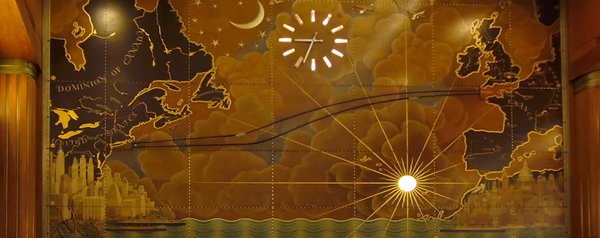
In the first session, Darlah Thomas explored the horological technologies of the 18th and 19th centuries at Liverpool Docks – the place where so many transatlantic journeys began and ended. Next, Alan Hughes examined the story of bells cast in Whitechapel for export to the new world – including one which rang in Philadelphia in July 1776 as the Declaration of Independence was read to the American public, now known as the Liberty Bell. Then, Kirsten Tambling took us on a transatlantic voyage to discuss the technology of time changes on ocean crossings, and how they were experienced by passengers.
After lunch, we held the formal AHS Annual General Meeting and our annual awards presentation.
The afternoon session was opened by Edward Gillin. In the twentieth century, Concorde became infamous for its high development and operational cost but, as Edward discussed, the saving of time in crossing the Atlantic at great financial expense had a long prior history. Next, Françoise Collanges accompanied us to the 1876 Centennial Exposition in Philadelphia to examine its horological displays, shining a spotlight on how national identities in the horology industries were shaped and made public. Finally, Steve Dutfield recounted the remarkable story of a Potts of Leeds turret clock made for Cardiff Docks, which ended up in an Alabama basement for 35 years before travelling back across the Atlantic and arriving in Cardiff, where its life had begun.
The lectures were as follows:
Darlah Thomas, 'Setting sail for America: horology at Liverpool Docks'
Alan Hughes, 'The sound of independence: English bells from Whitechapel to Liberty'
Kirsten Tambling, 'Keeping time, killing time: changing the clocks on transatlantic liners, 1911–1945'
Edward Gillin, 'From Cunard to Concorde: moral economies of time on the Atlantic'
Françoise Collanges, 'Sitting on a volcano: horology at the 1876 Centennial Exposition, Philadelphia'
Steve Dutfield, 'From Cardiff Docks to an Alabama basement and back: the transatlantic travels of a baby Big Ben'
AHS members can watch recordings of the lectures here.
The AHS Annual Meeting 2026 was supported by the kind sponsorship of Sotheby’s.