Tour of Edinburgh, 27–28 June 2025
Twenty-six AHS Turret Clock Group members assembled at the foot of the steps to Calton Hill in Edinburgh at the end of June, ready to take on the city’s many towers and belfries.
Organized by Mark Crangle, TCG Treasurer, and Sue Hines, Events Organizer for the group, the two-day tour featured a range of clocks in a variety of locations: some working, some dismantled, some with bells and some without.
Students from West Dean College and the Birmingham School of Jewellery were among those on board the chartered coach as it set off to see six turret clocks in and around Edinburgh on day one.
First stop was the Musselburgh Tolbooth. A tolbooth was the main municipal building of a Scottish burgh (town or city) from the late medieval period until the early 1800s. The clock, by an unknown maker, is now in a cabinet in the tolbooth lobby and may be the oldest turret clock in Scotland. It was an hour striking end-to-end cage clock donated by Dutch fishermen in 1496 for the town’s new tolbooth, reportedly in thanks for permission to fish the estuary where the River Esk flows into the Firth of Forth. The clock was converted to pendulum and a deadbeat escapement at some point in its history and served until it was replaced by a flatbed clock in 1901. The old clock was stored under a tarpaulin in the courtyard until it was brought in for display in 1930.
Interestingly, the clock is older than the building that now houses it. The original tolbooth was destroyed in 1544 during the burning of Edinburgh by the English, but the clock tower and octagonal belfry were salvaged and reused in the present building, which was completed in 1590.
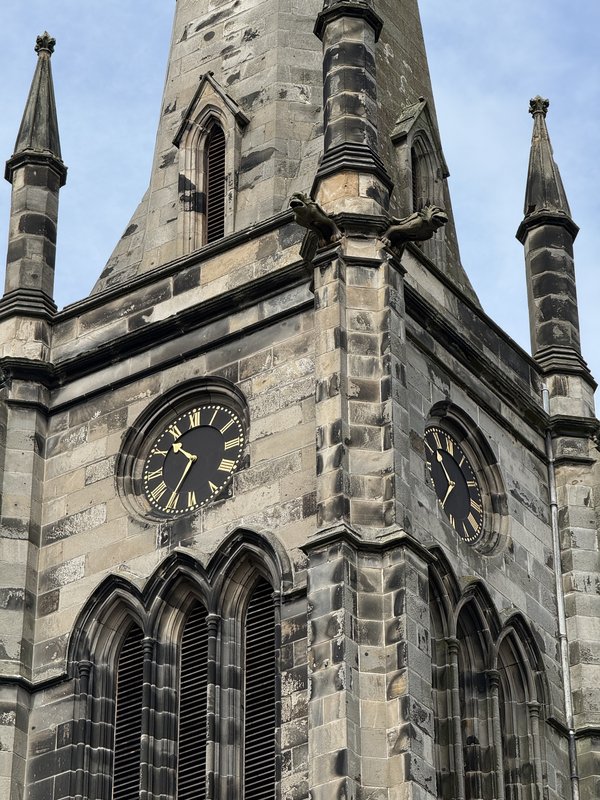
Next on the agenda was a visit to a Benjamin Lewis Vulliamy two-train turret clock in the tower of a church now used as a joiner’s workshop in Dalkeith, Orocco. The clock is still hand wound weekly and requires 70 turns to wind the weights for the striking train and 80 for the going train. The tower has four Vulliamy slate gilded dials. The dials are stepped in the centre, so that the hour hand, on a lower level, points directly at the hour numbers, while the minute hand points neatly at the minute indicators, removing the parallax effect.
Climbing a few at a time up a long circular stone staircase with no handrails, and then moving up two long ladders, we reached the clock. Some of us were in the tower observing the clock when the Mears and Stainbank bell struck 11. It was quite the experience! Organizing care for the clock is now the responsibility of the building owner, who runs a workshop making bespoke furniture. It has no current servicing, and some members of the tour noted a few dry spots in the clock’s movement.
The third stop of the day required no climbing. We visited the James Ritchie & Son workshop, now located on the Drum Estate on the outskirts of Edinburgh. James Ritchie & Son was probably the best-known clockmaker in Edinburgh and was involved with four of the clocks on our tour. In the beginning of this century the company split: the turret and public clock part of the business became part of Smith of Derby, while the antique clock section was bought by Jon Reglinski, our host for this visit.
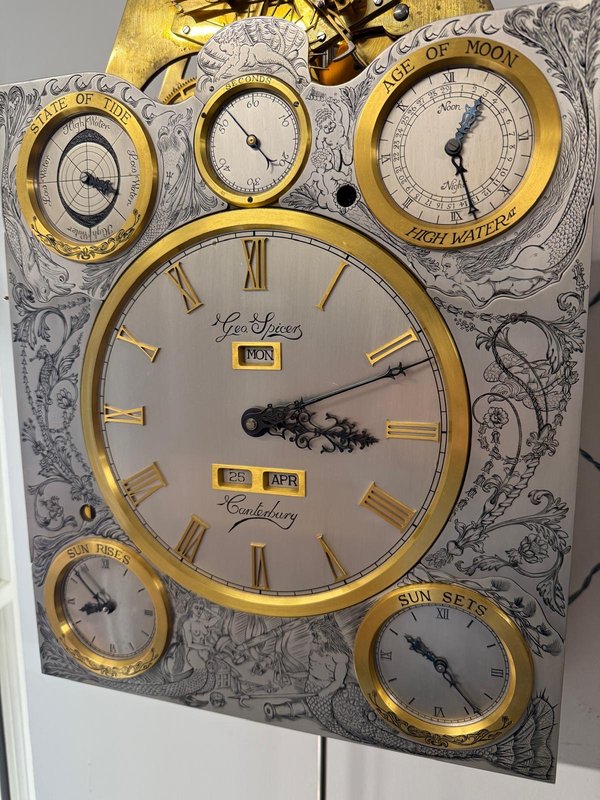
His compact shop had an amazing selection of longcase clocks and regulators, as well as a clock signed George Spicer of Canterbury that not only tells you the time, day and date, but has dials for the state of tide, the age of moon and high water, sun rise, sun set, and seconds.
Just outside the workshop are the dial and hands of a turret clock, leaning against a wall as a sort of sign. Reglinski said he bought the dial, hands and movement on eBay and doesn’t know anything about the clock or where it might have been originally sited. However, he says he does ‘have all of the parts so perhaps I can one day put it back into full working order (rather than more of a ticking ornament).’
Our last stop before lunch was the church of St Andrew & St George – otherwise known as Edinburgh New Town Church of Scotland, on George Street. This was the saddest stop of our tour. The 1788 Thomas Reid two train clock has been removed from its place in the tower and lies jumbled in the corner of a storage closet in the church’s basement. In 1862 the clock was converted from a 30-hour to an 8-day movement by Charles Gray of Edinburgh, and altered to a one-second pendulum by James Ritchie in 1938. In 2003 the bells in the church steeple were rehung and a synchronous clock movement was installed, with permission given for the replacement on condition the old clock remained on site. We were able to climb a veritable obstacle course of old and new beams in the steeple and see the bells and the ringing chamber. While they were impressive, they could not overcome the sense of loss rising from below.
After lunch we visited St Stephen’s – formerly a church, now a theatre and for-hire venue. The building is home to an 1823 James Ritchie two-train clock with the longest pendulum in Europe. At about sixty feet it took about 4.5 seconds to complete its swing. The clock had been hand wound until 2016, when it was converted to automatic winding. Unfortunately, in 2023 the clock was converted to synchronous electric with a chain drive on the centre arbor, but at this location the movement was left in place, although the pendulum no longer swings.
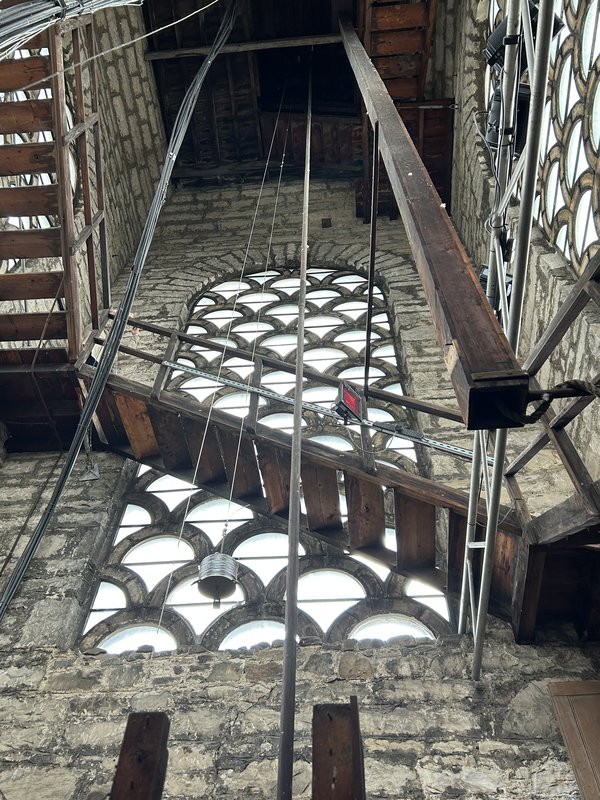
Because of space constraints at St Stephen’s we divided into two groups; the first climbed a terrifying and rather uneven set of open stairs up the 160 foot tower passing huge glass windows, while the second walked a narrow path behind the parapet surrounding the roof of the main building to take in expansive views of the city. After a suitable interval the groups traded places.
When we all had returned to theatre level, we were treated to an impromptu concert by Turret Clock Group member Stewart Whillis on an organ made by Henry Willis & Sons.
The last stop of day one was Broughton Parish Church, where we inspected an 1825 James Clark two-train count-wheel-striking turret clock now used as a timepiece only. The movement was converted to gravity escapement and new glazed skeleton dials installed by Robert Millar of Edinburgh. This was the last job he carried out before he was murdered on 1 January 1861 at the age of 42.
Friday evening saw the group convene for dinner at Canon’s Gait Pub on the Royal Mile. There was no official program, although Keith Scobie-Youngs gave a short address and James Nye made everyone change seats before dessert!
We were on foot for day two in Edinburgh, and whilst there was only one tower to climb there were lots of hills and stairs in the city itself. I think my fitness tracker recorded more than eighty flights of stairs, but only about fifteen of them were in a tower!
We met outside St Giles Cathedral and while waiting for the group to gather, we became spectators at one of the Orange Order parades that take place during so-called ‘marching season’ which culminates with the 12 July celebration of the Protestant victory in 1690 at the Battle of the Boyne in Ireland.
When the marchers and musicians cleared the Royal Mile we went into the cathedral and split into groups to take turns going up the tower, which is accessed by a very long stone spiral staircase.
Looking at the cathedral from the street, one sees no sign of a clock – there are no dials. James Ritchie thought the dials spoiled the look of the tower and gave his clock to the cathedral in 1912 on condition that they be removed. The three-train flatbed has ting tang quarters, a gravity escapement and a 20-second spring remontoire.

The cathedral’s first clock was installed in 1552 and replaced in 1584. The present clock is the fourth for the cathedral and replaced a Langley Bradley quarter-chime turret clock from 1721 that is held by the Edinburgh Museum. A scale model of the St Giles clock is in the National Museum of Scotland, but more on that later.
On leaving the cathedral, an elegant building with amazing stained glass, a modern interior layout, and an astonishing organ, we went down stone steps and a steep hill to the Magdalen Chapel. This is home to a two-train cage clock from the late 1600s that most of us were content to see via photos that Mark had taken on an earlier visit. As he said, ‘…access to the clock movement is not for the faint-hearted, but we will allow some to climb the ladders but only one at a time.’
We had a very interesting presentation on the history of the building. It was built as a Catholic chapel in 1541, but converted to protestant use after the Reformation in Scotland in 1560. The chapel has the only pre-Reformation stained glass in Scotland, which apparently escaped destruction because the images are of coats of arms, not religious figures.
After the death of the Magdalen Chapel’s founder, his widow gave the building to the Incorporation of Hammermen of Edinburgh, a trade association representing all those who worked on metal with a hammer, to ensure its continuity and care. The building is now owned by the Scottish Reformation Society and is no longer used for regular worship services.
The Edinburgh Hammermen, much like the Worshipful Company of Clockmakers in London, controlled access to their trades within the city’s boundary. The Magdalen chapel was home to the organization and clockmakers were among those attending meetings there. There are some notable names on the wall plaques, including Humphrey Mills, one of Edinburgh’s early clockmakers.

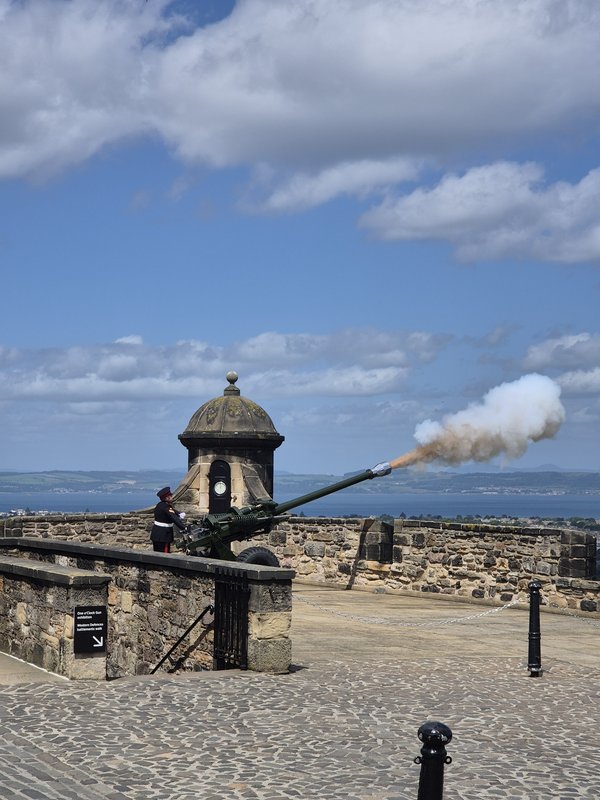
Our next stop was back up the hill to the Royal Mile to Edinburgh Castle to get in position for the one o’clock gun time signal. The gun signal began in June 1861 to allow ships in the Firth of Forth to set their maritime clocks. Previously navigators had relied on a visual sighting of the time ball drop at one o’clock from the top of the Nelson Monument on Calton Hill, but fog often made this impractical.
The penultimate stop of the tour was the National Museum of Scotland, where there were two clocks to see. The first was the Millennium Clock, which is a static exhibit until it comes to life for about five minutes on selected hours. The more than ten-meter-tall construction of metal, wood and glass represents the tragedies and achievements of humankind. Set to the music of a Johann Sebastian Bach Concerto, motion and lights begin at the base and work their way level by level to the top. Scenes representing Hell, atrocities, and scientific and cultural advances are illuminated in turn.
It is clear this is a showpiece, not a timekeeper. The clock at the heart of the action is an 1880 H&R Millar hour-striking turret clock that was rescued from a farmer’s barn in the Scottish Borders. It has a 2.2-meter pendulum weighing 26 kilograms. While the pendulum can be seen to move, the hands on the clock dial do not, leading us to suspect that while electricity powers the performance, the clock itself is not functioning.
The next stop at the museum was the model James Ritchie made of the clock he gave to St Giles Cathedral. The three-train movement with gravity escapement has Westminster quarters on tubular bells and one internal dial. The clock is hand wound and the museum curator, Tacye Phillipson, said she adjusts its timekeeping by adding or removing weights from the pendulum as needed. She opened the glass case of the model so we all could get a good look.
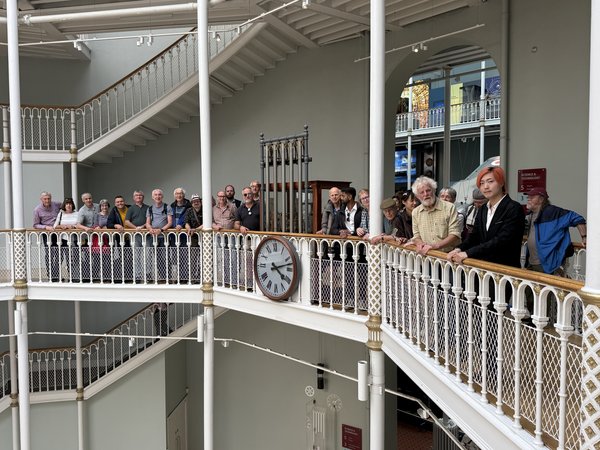
At that point it was time for a group picture with us all around the clock on the museum balcony.
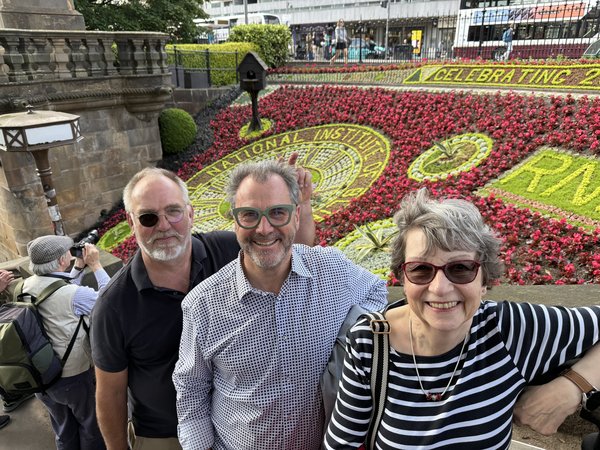
We finished our 2-day visit with a walk to the famous Floral Clock. As the sun was still shining, we went down to Princes Street Gardens to see the freshly planted clock. Each year the clock and its surroundings are planted with a theme: this year’s marks the 200th anniversary of the invention of braille.
The clock began as an experiment in 1903 and was the idea of John McHattie, park superintendent, along with James Ritchie Clockmakers. In its first year the clock had only an hour hand, in 1904 a minute hand was added, and the cuckoo followed the next year. It has become a firm favourite with tourists and has been planted every year since.
The Floral Clock was a favourite with us too, even though it signalled the end of our circuit around Edinburgh’s turret clocks. But we didn’t see them all – so there’s a reason to return.
Penny Dixon Gumm, West Dean student
Unless indicated otherwise, all photos © the AHS Turret Clock Group.