The AHS Blog
Happy Birthday to The Duo!
This post was written by Kirsten Tambling
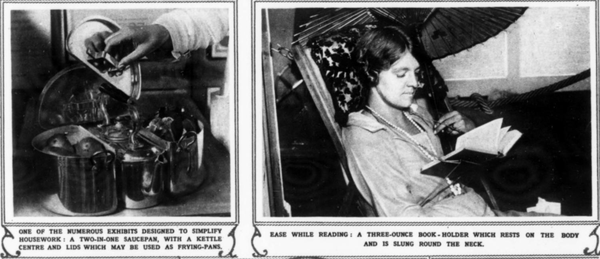
One hundred years ago this month, London witnessed the second Exhibition of Inventions, organised by the Institute of Patentees at Central Hall, Westminster. Exhibiting alongside a two-in-one saucepan and a three-ounce book holder was a remarkable clock made by professional engineer and amateur clockmaker Ffolliot Gray.
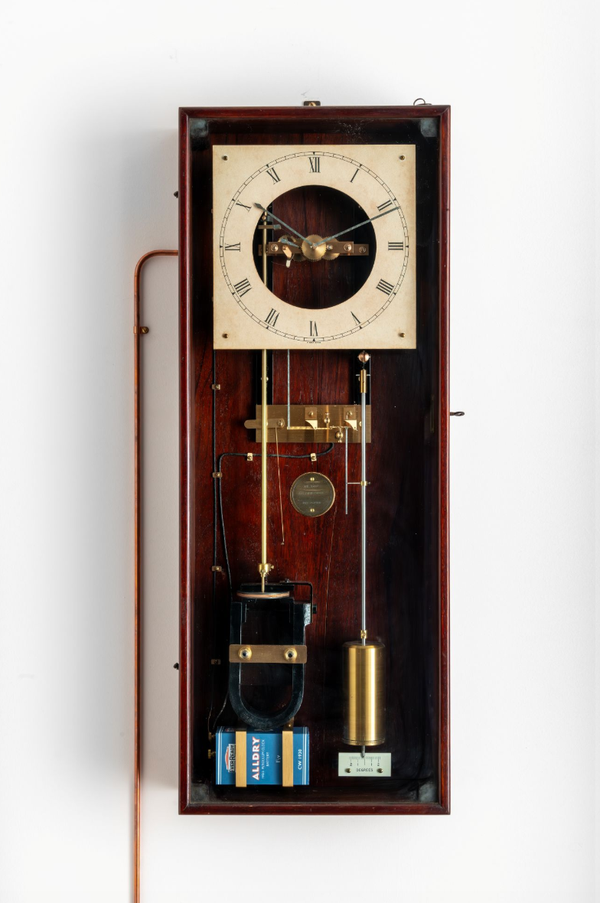
‘The Duo’ is a double pendulum clock, probably inspired by the work of William Hamilton Shortt, whose ‘Free Pendulum’ had been unveiled by the Synchronome Company in 1921. Shortt’s clock divides the work of timekeeping between a pendulum in a vacuum tank and a secondary clock with which it is electrically synchronised. It remained the world’s time standard until the discovery of quartz at mid-century.
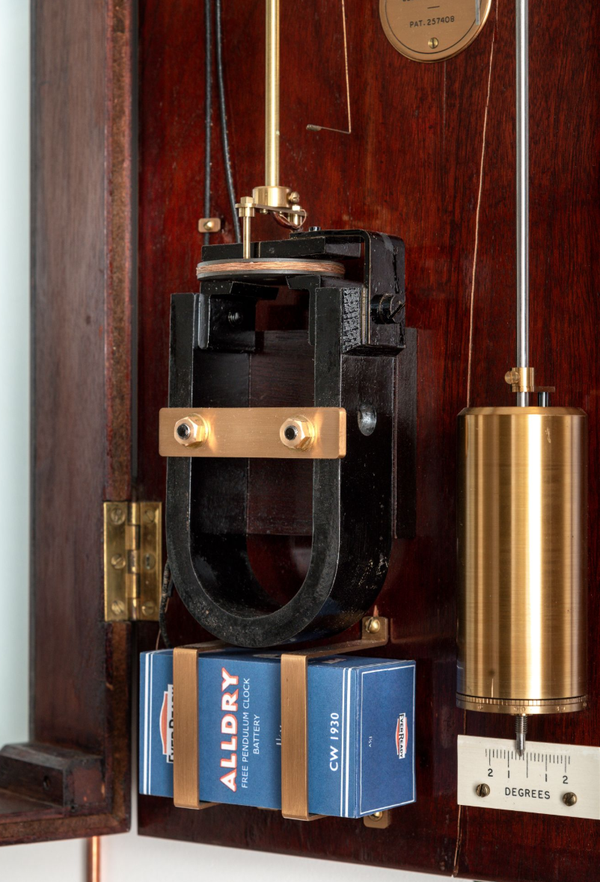
Gray’s clock also divides the timekeeping work between two pendulums: a drive pendulum, on the left, and a time pendulum, on the right. The drive pendulum advances the hands via a pecking pawl linked to the motion work. Electromagnetism sustains it: the bob is an electromagnetic coil moving through the field created by a permanent magnet. The coil is impulsed via a switch. As the pendulum oscillates, it brings an L-shaped arm into contact with a stop, closing the circuit. As current flows into the coil on the drive pendulum, the coil is repulsed from the magnet.
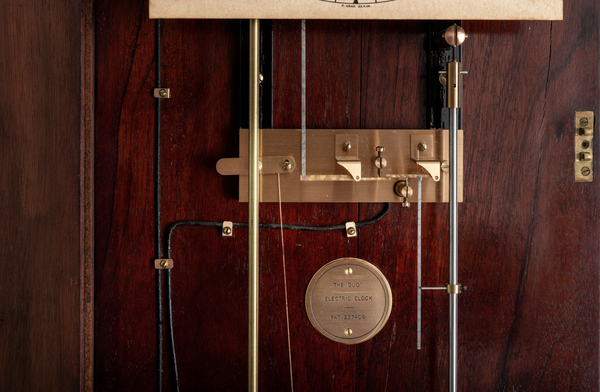
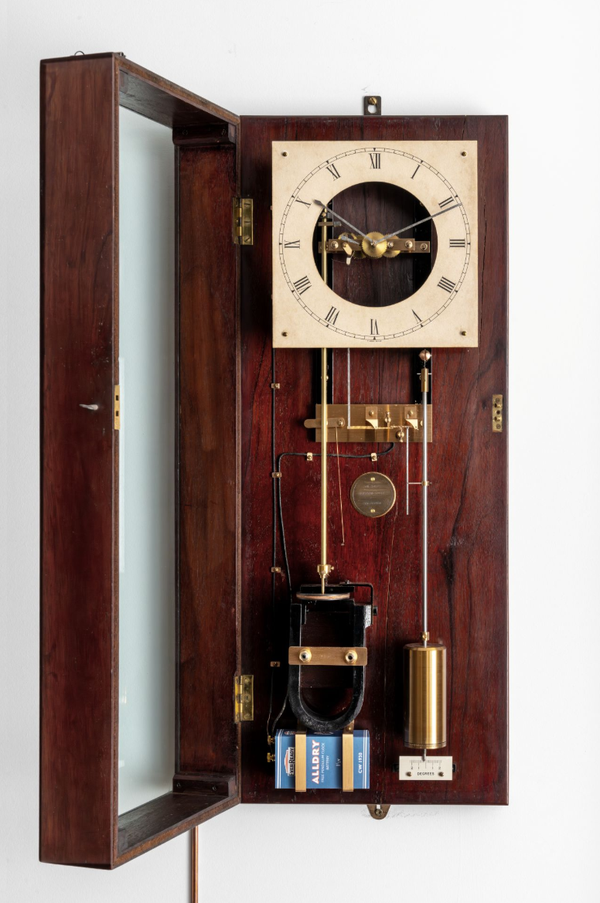
Meanwhile, the movement of the time pendulum lifts and lowers another L-shaped arm, in turn breaking the circuit every time the arm meets a second stop. Gray’s masterstroke is a tiny lift to the right-hand arm at the end of its journey, which ensures there is always slightly more energy travelling to the time pendulum than away from it.
The clock is remarkably silent and low in friction, and keeps time well, but as Gray never moved into commercial manufacture, only five were ever made. Each is slightly different from the last, and the whole group offers an intriguing insight into Gray’s process of development and iteration. By the final clock, he was experimenting with time distribution via a repeater-transmitter, thus tapping into another major trend in contemporary electrical timekeeping.
The example at The Clockworks is displayed with the ‘Certificate of Merit’ it won at the Exhibition of Inventions between 13-23 October 1926. Exactly a century on, it is still ticking.