The AHS Blog
A dial with a story?
This post written by James Nye
A happy outcome of AHS ‘bring and discuss’ meetings is the spotlight they can turn on an object which has received little attention until a group of people take a closer look.
This was the case with an eighteenth century 30-hour longcase clock movement, signed for Edward How of Holford in Somerset, numbered 134 on the dial. The movement is relatively straightforward, though with rack-striking. Another clock numbered 141 was noted in Clocks Magazine in July 1994.
Edward How was a Somerset country clockmaker active in the later eighteenth century, associated with Holford and Bishops Lydeard on the Quantock fringe. Part of the wider How family of makers and repairers, he appears in records from 1753 to 1805, though this may represent more than one man of the same name.
In October 1758 we know he took an apprentice. He repaired parish clocks in villages such as Crowcombe and Kingston St Mary, supplied a new church clock at Crowcombe in 1776, and in 1788 contracted to make another for Lydeard St Lawrence. Several longcase clocks signed Edward How, Holford bear dates in the 1766–70 period: all oak-cased thirty-hour examples with square brass dials, like this one.
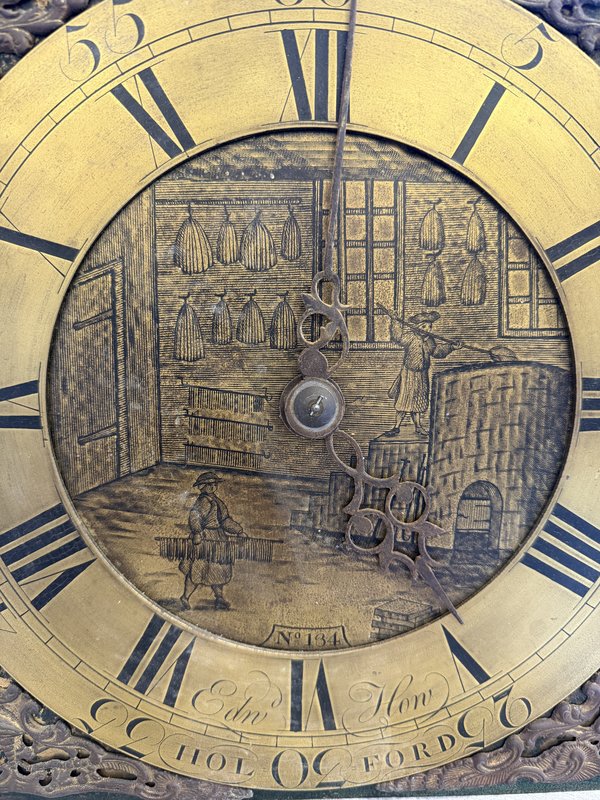
The particular feature of this clock is the engraving to the centre of the brass dial, which appears to show the interior of a tallow chandlery.
At right, a workman stands beside a large, heated vat or cauldron, where rendered tallow is being prepared or kept molten for use. In the left foreground another figure carries a rod or frame from which newly formed candles are suspended in rows, suggesting the repeated dipping process by which tallow candles were built up layer by layer. Around the walls hang further batches of finished or drying candles.
This lively vignette of a mid-eighteenth-century craft interior is of particular significance to the present owner, whose ancestor Henry Maynard was indeed a tallow chandler, living in Kingston St Mary, only 11 miles from Holford. He died in 1830, leaving £360 in a bank account at the Bank of England, though regrettably his will makes no mention of a clock. Perhaps his father before him was also a tallow chandler, in which case he might have been the first owner. Alternatively, perhaps the clock was a wedding present for Henry and his bride in 1770.
Whatever the story, the clock has remained in the family for several generations, and it is tempting to suppose that it was originally acquired new by an ancestor whose trade was reflected on the dial.
Source: A.J. Moore summarised a lot of material about the Hows in Clocks Magazine (September 1994).