The AHS Blog

Measuring the mind
This post was written by Kirsten Tambling
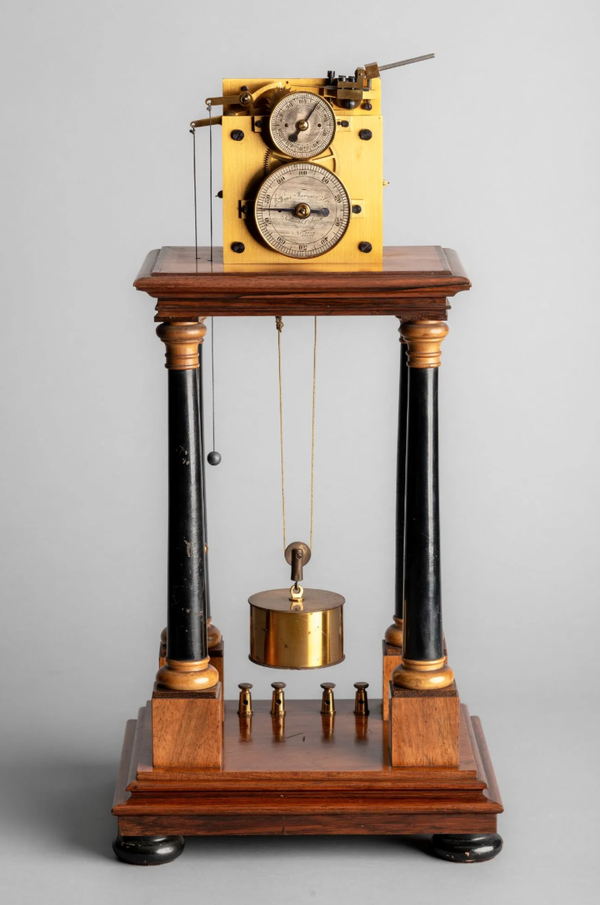
Matthӓus Hipp’s chronoscope was one of the first effective short-duration timers, capable of measuring thousandths of a second – and a clockmaking achievement with profound implications.
The chronoscope made its scientific debut with the Director of Neuchâtel Observatory, Adolphe Hirsch. Hirsch was interested in studying and systematising what astronomers called the ‘personal equation’ – tiny discrepancies between measurement of the same stellar events, caused by differences in what we would now call reaction times.
Hirsch seems to have been on good terms with Hipp, who not only supplied the chronoscope but also offered himself as a subject for his experiments. The final paper, published in 1861 and immediately translated into several languages, proved several concepts we accept today, such as the primacy of auditory stimulus, and the fact that we react more slowly to anything if we’re tired.
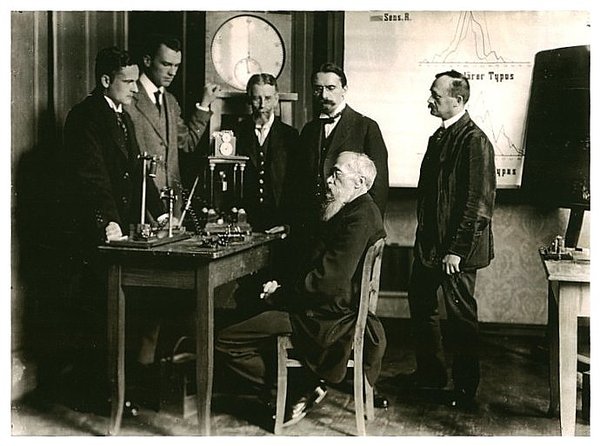
Another researcher, Wilhelm Wundt, quickly saw the possibilities for his own interest in sensory impressions and consciousness, and in a contemporary photograph, Wundt and his research students are shown gathered reverently around a Hipp chronoscope. In 1879, Wundt established one of the world’s first laboratories of experimental psychology; by 1900, there were 50 such laboratories worldwide, all featuring a chronoscope as standard. One of these, in Freiberg, was established by Wundt’s former student, Hugo Münsterberg, later known as a pioneer of forensic psychology.
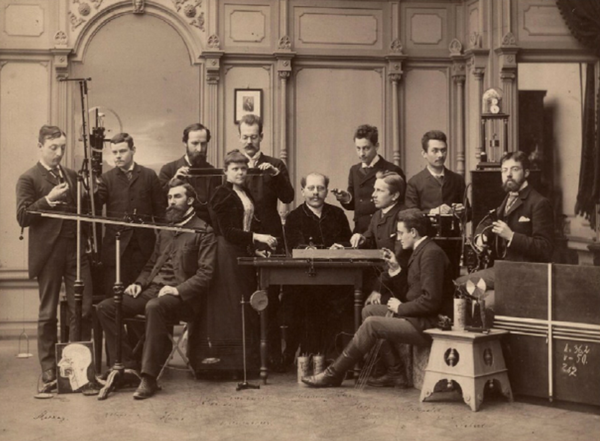
In 1891, Münsterberg sent American psychologist and philosopher William James a photograph of himself with his own students – including Resa von Schirnhofer, one of the first women to study for a doctorate. They appear to be having fun: Waldemar Lewy, then working on memory, is pointing a pistol key at his teacher’s head.
The photograph was taken in a studio, where every element would have been carefully curated. A framed photograph of Wundt at the back is a pointed statement of intellectual lineage – supported, at the far right, by a Hipp chronoscope.
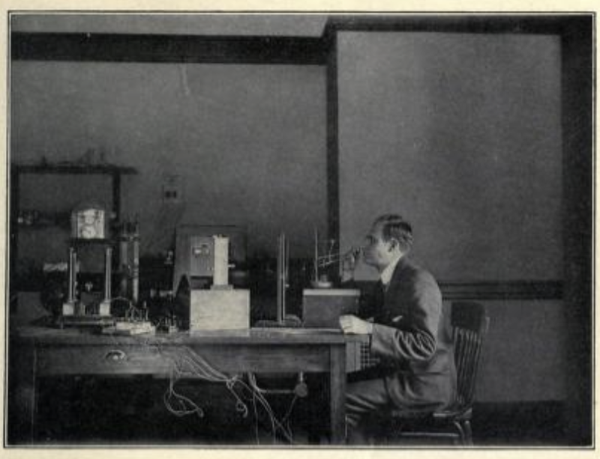
The chronoscope is still referenced as ‘the standard instrument for measuring mental processes in thousandths of a second’ in Münsterberg’s Business Psychology of 1918, but gradually the precision instruments of the ‘Physiological Psychology’ espoused by Wundt were superseded by the more philosophical approach with which we are now most familiar.
Even so, Hipp’s chronoscope had been of foundational importance in establishing this new discipline – which could only get going once it had a timebase to go on.