Keeping time afloat
This post was written by James Nye
Clocks often need fixing, especially when badly worn or broken. But what about repairs before a clock reaches its first owner? Production lines like those at the Smiths alarm clock factory had systems for identifying rogue movements and adjusting them before they left the plant. Travel back in time and we can find occasions of things going badly wrong once the clockmaker had shipped an item, before it reached the client. Damage on a voyage was a risk.
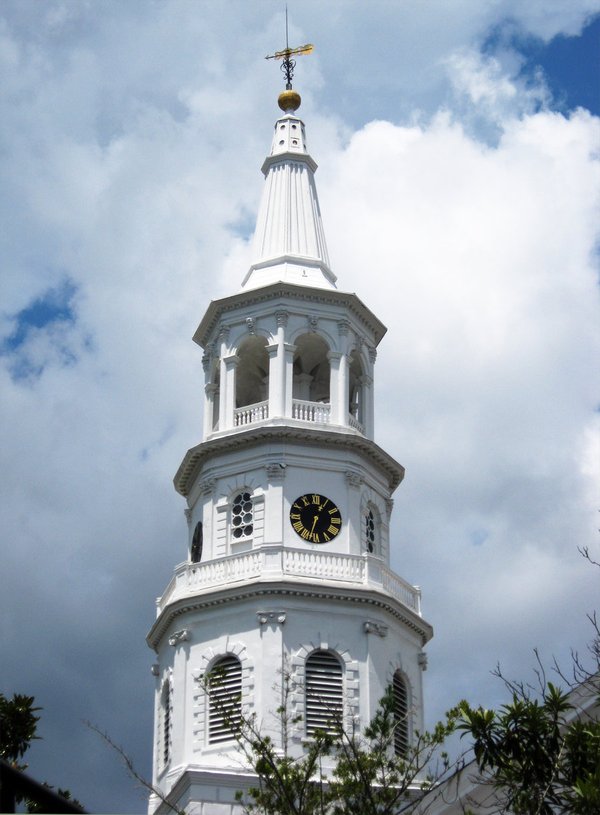
When Thwaites received an order in 1763 for a turret clock for St Michael’s church, Charleston, South Carolina, the church officials were nervous. The clock was shipped on the Little Carpenter, commanded by Captain Muire, with instructions to pack the clock in that ‘part of the Vessell least Apt to Damage goods Either by Water, or Occasion Breakage by the Extraordinary Weight of Other Goods stowed Above, be Appropriated for the Clock and Bells as Bruising the One or Cracking One or more of the Others will be to us an Irreparable Damage’.
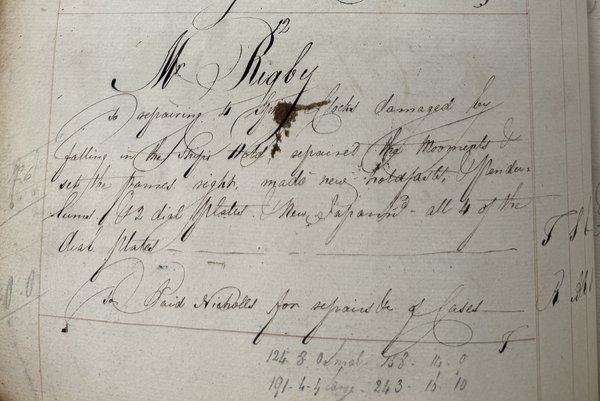
The clock survived the Atlantic, but another client was not so lucky. In September 1806, Thwaites invoiced regular client Mr Rigby, for ‘repairing 4 spring clocks damaged by falling in the ships hold, repaired the movements & set the frames right, made new holdfasts, & pendulums & 2 dial plates, new japanned all 4 of the dial plates’.
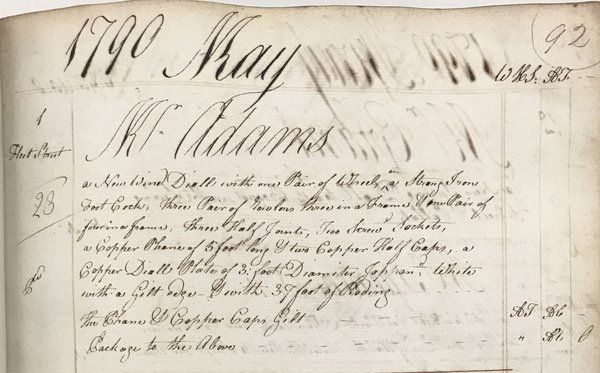
One more example – where remarkably we can recover even more detail. In May 1790, Thwaites supplied a wind dial to instrument maker George Adams of 60 Fleet Street. But in September it was back in the workshop where Thwaites cleaned ‘all the Work of a Wind Diall New Turned all the Wood Rowlers Painted the Rods New Jappann’d the Diall Plate New Gilt the Phane Repair’d the Packing Cases & Packed it up’.
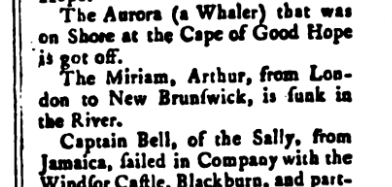
Thwaites had dispatched the dial by ship, but in July 1790, the Miriam sank in the Thames on her way to New Brunswick. Some of the cargo was saved, among which were the packing cases, duly returned to Thwaites (‘sent back the Ship Having Sunk in the River Thames’).
One suspects the incident prompted some rueful reflection in Clerkenwell: proof that even the most careful packing cannot always prevent that sinking feeling.
References:
St Michael’s, Charleston, ‘The Bells and the Clock’, in George Williams, St Michael’s, Charleston (University of South Carolina, 1951), 234–308.