Not quite bombproof
This post was written by James Nye
It has become a cliché to describe solutions or products as bombproof—supposedly immune to attack or criticism—without ever imagining real bombs. This word came to mind recently when considering the survival of three turret clocks in near unbelievable circumstances.
My first encounter with such a story came in uncovering the later life of the clock installed at London’s Chelsea Old Church in 1761, made by Edmund Howard (1710–98). During the Blitz, on the night of 16/17 April 1941, several 1,000 kg aerial mines destroyed the church.

Informed opinion suggests the fall of over 1,000 tons of masonry as the tower collapsed, bringing down the clock movement. In the late 1950s it was observed by AHS members in the workshops of Dent, where bomb damage was evident: the central train bar can be seen bent over at the top. Remarkably, a seemingly fragile wrought-iron clock survived such a catastrophic fall amid the rubble.

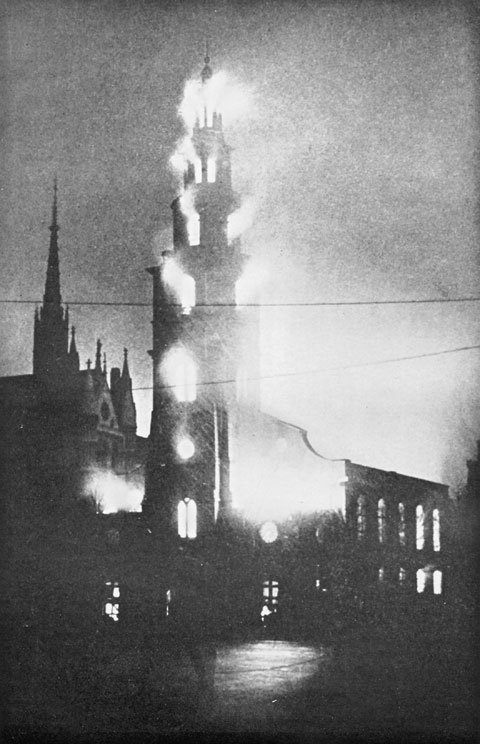
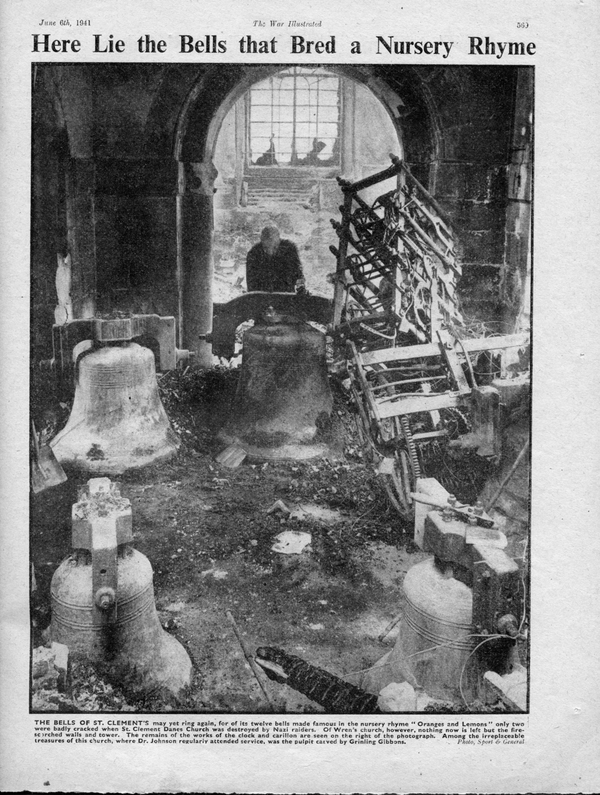
This was not unique. On the worst night of the Blitz (10/11 May 1941), incendiary bombs hit St Clement Danes Church in London’s Strand, nearly destroying the entire fabric. As a photograph from Sports & General shows, the immensely heavy Langley Bradley clock and its tune player nevertheless reached ground level relatively intact. The clock was nearly 10 feet wide and 6 feet tall, with great wheels about 32 inches in diameter and perhaps 1¾ inches thick, set in a massive cast-iron frame. This colossal assembly fell as the floors of the tower collapsed in the fire, yet the photograph suggests remarkably little obvious damage.
A final and related example lacks quite the same drama, but is no less intriguing. The Inner Temple Library was hit earlier than the other two sites. It was early on 19 September 1940 that a bomb sliced through the library tower, destroying a large part of the structure and one of the four 6-foot clock dials, perhaps damaging the John Moore & Sons hour-striking clock installed as recently as 1871.
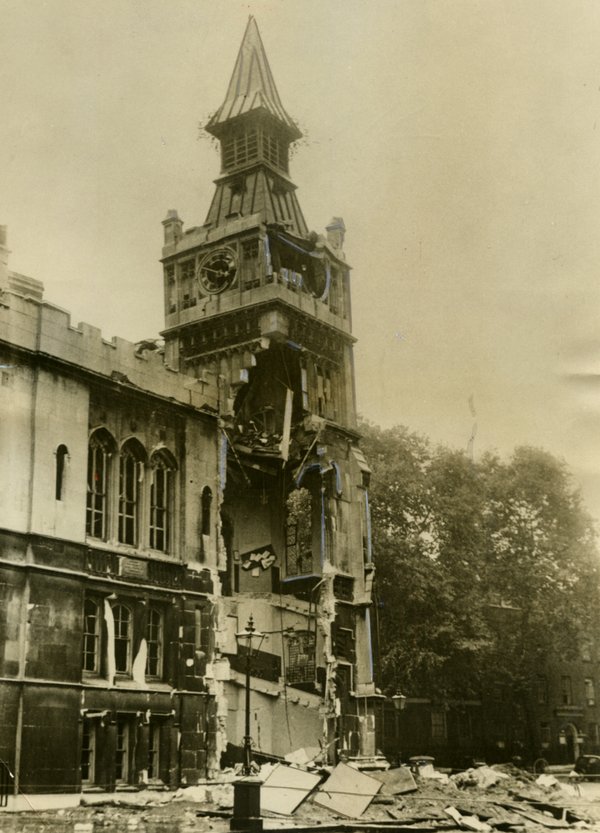
When the compromised tower was demolished soon after, the dials had already been removed, inviting speculation that careful horological salvage had taken place. If so, one might hope the movement survived and was recycled, as we also hope for the Chelsea and St Clement Danes clocks. If anyone has any information on the later histories or whereabouts of these three clocks, all now lost to view, please let me know!
